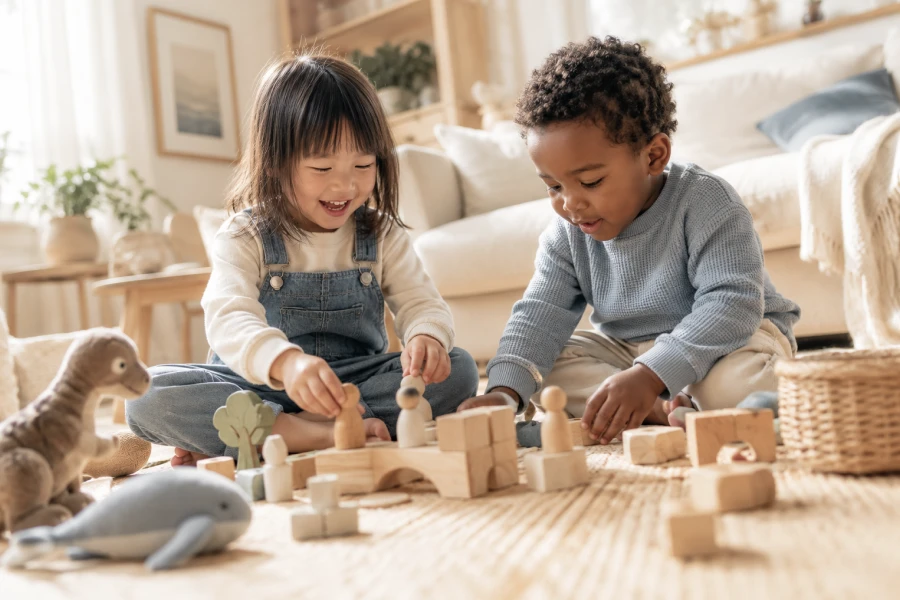
Play based learning activities help children explore ideas through familiar, low-pressure experiences without separating discovery from enjoyment. A cardboard box can become a store, spaceship, theater, or sorting station. Each transformation invites language, planning, movement, and flexible thinking. Adults do not need elaborate supplies to support meaningful learning. They need time, attention, and permission for children to experiment. The strongest activities leave room for unexpected questions and changing rules. This approach supports learning through play while reducing pressure to perform correctly. Children often stay engaged longer when they help shape the experience. Learning becomes something they do rather than something delivered to them. Ordinary afternoons gain purpose without losing their warmth or spontaneity.
Play feels natural because children use it to test how the world works. They repeat actions, change variables, and watch what happens next. A tower teaches balance before anyone introduces formal engineering vocabulary. Pretend cooking develops sequencing, counting, memory, and social negotiation. Outdoor collecting builds observation and classification through genuine curiosity. Adults can deepen these experiences with simple comments and thoughtful questions. Avoid turning every playful moment into a visible lesson. Children need ownership, humor, and room to make unproductive choices sometimes. Natural learning grows when exploration remains emotionally safe. Play gives developing minds a flexible laboratory they can enter every day.
Children reveal interests through the objects, stories, and challenges they revisit. Watch before suggesting a new direction or correcting their method. A child arranging toy animals may be exploring size, family roles, or patterns. Ask what is happening instead of guessing what the play should become. Follow-up questions can extend creative activities for children without taking control. Offer one new material when energy begins to fade. A measuring cup, flashlight, scarf, or cardboard tube can shift the investigation. Flexible timing allows children to remain with an idea long enough for deeper thinking. Adults can document interesting comments without interrupting the flow. Following the child creates learning that feels personal and worth continuing.
Play develops academic and life skills at the same time. Building strengthens spatial reasoning, persistence, planning, and fine motor control. Role-play expands vocabulary while children practice empathy and social problem solving. Board games introduce counting, patience, strategy, and disappointment management. Art experiments encourage observation, choice, and tolerance for uncertain outcomes. Movement games support coordination, listening, memory, and self-regulation. These experiences resemble preschool learning ideas because skills grow through meaningful context. Parents can notice progress without testing children after every activity. Repeated play naturally increases complexity as confidence develops. The same simple experience can support several forms of learning simultaneously.
A useful learning space feels inviting without overwhelming children with choices. Rotate a small selection of materials rather than displaying everything at once. Keep frequently used supplies visible, reachable, and simple to return. Use trays, baskets, or low containers to define activity possibilities. A washable surface makes experimentation easier for children and adults. Include open-ended materials that can serve many purposes. Blocks, paper, tape, fabric, and natural objects offer excellent flexibility. A calm setup supports homeschool activity ideas without making the home resemble a classroom. Children should know which areas allow mess and which require extra care. Clear boundaries protect freedom because everyone understands how the space works.
The same play idea can change shape as children grow. A toddler may sort large objects by color or texture. An older child might create categories, record totals, or invent a scoring system. Younger children need simpler materials and closer safety supervision. Older learners often enjoy adding stories, rules, research, or friendly competition. Siblings can share an activity when each person receives an appropriate role. Avoid comparing outcomes because age changes attention, coordination, and language dramatically. Adapt the challenge while preserving the playful core. Children remain more engaged when success has several possible forms. Flexible activities grow with the family instead of being discarded after one season.
Simple materials encourage imagination because they do not announce one correct purpose. Cardboard, water, string, paper, and household containers invite transformation. Children must decide what an object represents and how it should function. That decision-making adds creativity before the activity officially begins. Low-cost materials also reduce adult anxiety about damage or imperfect results. Families can repeat successful ideas without waiting for a special purchase. Cleanup becomes part of sorting, responsibility, and planning. Photograph a creation when children want to preserve it before recycling materials. The value lives in the thinking, not the permanence of the final object. Simple resources often produce the richest stories because children supply what is missing.


Leave a comment