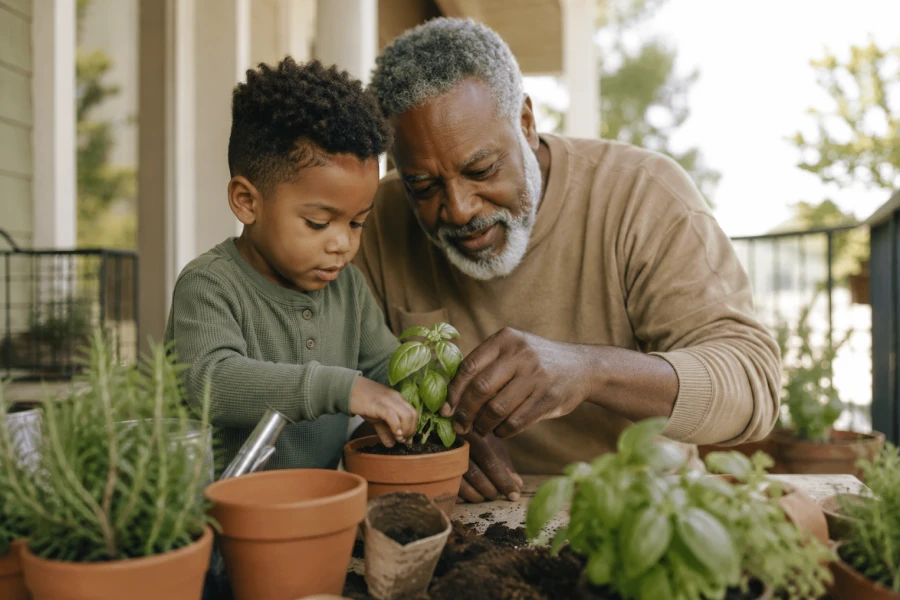
Hands on learning for kids connects ideas with movement, texture, sound, and visible change. Children understand volume differently after pouring water between containers themselves. A paper bridge makes balance and structure more memorable than a definition alone. Physical experience gives abstract ideas a place to attach. It also allows children to test, adjust, and try again independently. Adults can support the process without controlling every decision. Well-chosen indoor learning activities turn ordinary materials into meaningful experiments. Children gain confidence when their actions produce understandable results. The lesson becomes part of a story they personally helped create. That combination of thinking and doing often makes learning easier to recall.
Stronger connections form when several senses participate in the same experience. Touch, movement, and observation provide different routes into one concept. A child measuring ingredients sees numbers become changes in texture and quantity. Building a model reveals relationships that a flat picture may hide. Hands-on work also gives immediate feedback without waiting for adult correction. A tower falls, a mixture changes, or a shadow moves. These responses encourage children to revise ideas naturally. The process values experimentation instead of rewarding only finished accuracy. Children often explain more when they can point to what happened. Physical evidence supports language, memory, and increasingly precise reasoning.
Useful materials do not need to be expensive or specialized. Containers, clips, tape, paper, fabric, blocks, and natural objects offer broad possibilities. Choose items that children can combine, rearrange, and use in several ways. Open-ended materials create more decisions than toys with one fixed outcome. Keep safety, age, and supervision needs central when selecting small or breakable objects. Outdoor collections can support outdoor learning activities through sorting and comparison. Invite children to help gather and organize supplies. Ownership begins before the main activity starts. Rotating materials can renew interest without adding more possessions. A small, thoughtful collection often produces deeper play than an overflowing shelf.
Movement helps many children organize attention and understand spatial relationships. Counting jumps turns number practice into rhythm, balance, and memory. A scavenger hunt connects reading clues with observation and physical action. Large floor shapes can introduce patterns, geometry, and directional language. Children may act out stories to explore sequence and character motivation. Movement also offers natural breaks during activities that require concentration. Parents can alternate quiet and active tasks instead of demanding long stillness. This rhythm respects developing bodies while preserving educational purpose. Active learning should remain playful, safe, and adaptable to available space. When movement supports the idea, energy becomes a resource rather than a distraction.
Problem solving grows when children face challenges with more than one reasonable solution. Ask them to build a shelter, move an object, or create a stable ramp. Provide constraints that inspire thinking without making success impossible. For example, limit materials while allowing several designs. Resist fixing the first difficulty before children have time to observe it. A pause can lead to a new strategy, collaboration, or useful frustration. These challenges become problem solving games for kids when the tone remains curious. Encourage children to compare attempts rather than label one effort a failure. Revision teaches persistence and flexible thinking more effectively than instant rescue. The goal is not perfection but a growing willingness to approach uncertainty.
Conversation can deepen an activity when adults respond to what children actually notice. Describe actions without constantly praising or evaluating them. Say the tower became wider after the base changed. Ask what the child thinks caused a result or what might happen next. Use precise vocabulary naturally after the experience creates a reason for it. Children can repeat new words while touching the objects those words describe. Allow silence during concentrated work because not every insight needs immediate narration. Invite reflection after cleanup when attention becomes available again. A child’s explanation may reveal understanding that the final product does not show. Respectful conversation turns shared activity into shared thinking.
Mess and mistakes often signal genuine experimentation rather than poor behavior. Set clear boundaries before beginning, including where materials can travel. Use trays, washable surfaces, old towels, or outdoor spaces to reduce adult stress. Let children help clean because restoration is part of the complete process. A spill can introduce absorption, volume, or practical problem solving. A failed structure can reveal weight, balance, and material limits. Avoid shaming children for outcomes that were predictable within the chosen activity. Instead, adjust the environment and explain the new boundary calmly. Children become braver thinkers when mistakes remain manageable and repairable. Learning feels safer when experimentation does not threaten connection with the adult.

Leave a comment